Adam
Paradise LostAdam is the first human being and the first father of mankind, created from the dust of the ground and animated by the breath of God. His decisive significance lies in the double structure of his story: he is formed as a rational, upright creature capable of governing the created world, but his free choice to share Eve’s forbidden act makes him the representative source of humanity’s fallen condition. The poem therefore presents Adam not as a creature compelled into disobedience, but as one whose dignity includes the power to stand and the freedom to fall, whose ruin is later answered by the promised obedience and redemption of the Son of God.
Identity and Creation
Adam is made on the sixth day as the culmination of the created order. God forms him in the divine image, gives him a living soul, and distinguishes him from the brute creatures by reason, upright stature, self-knowledge, and the capacity to acknowledge the source of his goodness in devotion and worship. His humanity is thus defined not merely by biological form but by a moral and intellectual vocation: he is meant to understand, give thanks, and govern responsibly rather than remain prone and instinctual like the animals.
God appoints Adam and Eve to be fruitful, multiply, fill the Earth, subdue it, and exercise dominion over fish, birds, beasts, and every creeping thing. Adam’s authority is therefore presented as a commission within creation, not as an independent possession. He is brought into the Garden of Eden, where every pleasant fruit is provided for food, with one prohibition: he must not eat from the Tree of Knowledge of Good and Evil. The command is deliberately singular amid broad permission, making obedience the visible sign of his allegiance.
Adam’s first remembered experience, later related to Raphael, begins in radical unknowing. He awakens on the flowering ground, dries in the Sun’s warmth, rises instinctively to his feet, surveys hills, valleys, woods, plains, streams, birds, and animals, and discovers that speech comes readily to him even before he understands who he is or from what cause he exists. His questioning of the world leads him toward the recognition of a Maker superior in goodness and power. Sleep then brings an apparition that names him the First Man and directs him toward the Garden of bliss, transforming bewildered existence into a guided human origin.
Life in the Garden of Eden
In the Garden of Eden, Adam lives with Eve in an unfallen state of joy, love, labor, and direct openness before God and the Angels. The setting is a place of abundant water, fruit, flowers, groves, caves, lawns, flocks, birdsong, and an eternal spring. Adam and Eve are described as erect, godlike in appearance, and clothed in native majesty rather than fabric; because they think no evil, nakedness carries neither guilt nor shame. Their innocence is therefore both bodily and inward, expressed in their freedom to move through the garden without concealment.
Adam’s relation to Eve is intimate and hierarchical at once. He is formed for contemplation and valor, while Eve is formed for softness, grace, and attractive gentleness; he is represented as her guide and head, and she as flesh from his flesh. Yet their union is also mutual and emotionally central. Adam calls Eve his sole partner and the sole part of his joys, and he treats their shared labor of pruning plants and tending flowers as sweet rather than burdensome because it is undertaken together. His gratitude extends upward to God, whom he recognizes as infinitely good and generous, but his daily happiness is inseparable from Eve’s companionship.
Adam clearly understands the prohibition concerning the Tree of Knowledge of Good and Evil. He explains that death is the announced penalty, that the command is the single remaining sign of obedience amid their extensive dominion, and that the abundance of permitted delights makes the restriction easy to accept. His speech reveals a coherent moral understanding before the Fall: he can identify divine generosity, distinguish freedom from constraint, and see obedience as a grateful response rather than an oppressive demand.
The Fall and the Choice to Share Eve’s Fate
The crisis begins when Eve returns from the Tree of Knowledge of Good and Evil carrying its fruit. She tells Adam that the Serpent has eaten and gained human voice, reason, and an apparently higher degree of life; she claims that her own tasting has opened her eyes, enlarged her spirit, and offered a godlike ascent. Her stated motive is relational as well as ambitious: she sought the supposed transformation chiefly for Adam and urges him to taste so that their lot, joy, and love will remain equal.
Adam’s first response is shock. The garland intended for Eve falls from his slack hand, its roses scattering as horror passes through his body. He recognizes that Eve has committed the fatal trespass and that she is now exposed to death. At this point he understands the command well enough to perceive the catastrophe, but he does not choose separation. Instead, he decides that if Eve must die, he will die with her, because the bond of their nature makes her state his own. He imagines no life in the wilderness without her and declares, in effect, that losing her would mean losing himself.
Adam’s decision is both an act of extraordinary marital attachment and the pivotal human error. He reasons that the Serpent has tasted and survived, and he allows the apparent result to weaken the credibility of the divine threat. He also speculates that God, having created humanity as the chief of earthly works, would not wholly abolish it and permit the Adversary to triumph. These arguments do not erase his knowledge of the command; they show how affection, hope, and self-serving inference work together to make disobedience appear defensible.
Eve interprets Adam’s choice as an illustrious proof of love. She presents their union as one heart and one soul, and treats his willingness to share her guilt as an unparalleled confirmation that their bond cannot be divided by death. Adam’s love is therefore not a passive background sentiment: it becomes the immediate cause of his transgression. The poem makes the irony severe. The same union that embodies human companionship also carries guilt from the first pair into their posterity.
Judgment, Guilt, and Recognition
After the Fall, God sends the Son of God to judge Adam and Eve, combining judgment with mercy because the Son has already undertaken to become their ransom and redeemer. As the Son descends toward the Garden of Eden, Adam and Eve hear God approaching and hide among the trees. Their altered condition is visible in their faces and behavior: love has given way to guilt, shame, perturbation, despair, anger, obstinacy, hate, and guile.
When God calls him, Adam answers that he hid because he was naked. Pressed to explain how nakedness became fearful, he admits that he ate, but he also shifts responsibility toward Eve. He describes her as the companion God gave him and says that she gave him the fruit. The admission is therefore incomplete: Adam recognizes the act but does not initially accept its full moral burden. His appeal to necessity shows how quickly the former harmony between the pair has become a defensive struggle over blame.
The judgment reveals the consequences of Adam’s representative position. Because he is the root of human descent, his crime makes his sons guilty and transmits death through mankind. Yet the same representative structure allows restoration to proceed through a second root. The Son of God will join divine nature to human nature, become man among men, and stand in Adam’s place as the new head of humanity. Adam’s fall thus becomes the negative foundation against which the later obedience of the Redeemer is measured.
Prophecy, Instruction, and Final Significance
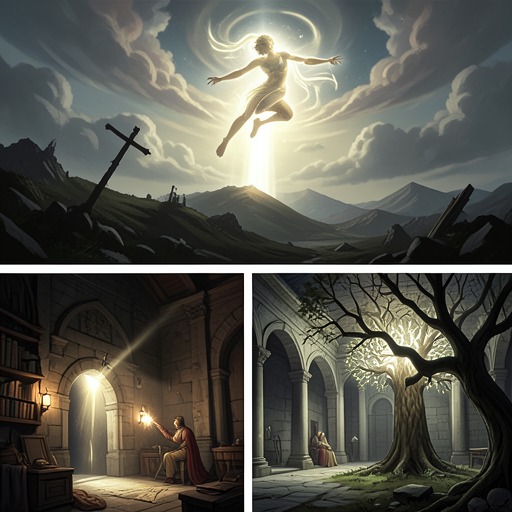
Adam receives the full shape of the promised remedy from Michael. The Son of God will fulfill the Law through obedience and love, take human flesh, endure reproach and a cursed death on the Cross, and offer life for Adam’s mortal crime. His death will satisfy the penalty due to transgression; his resurrection on the third dawn will defeat Death; and his ascension will lead the powers of darkness captive. The prophecy also extends beyond Adam’s immediate descendants: the Redeemer’s salvation will be taught to all nations, and blessing will reach the sons of Abraham’s faith throughout the world.
The prophecy changes Adam’s understanding of the Fall without canceling its seriousness. The Son’s work will not simply destroy Satan as an external enemy; it will destroy his works in Adam and in Adam’s seed, defeating Sin and Death, the two principal powers of the fallen condition. Adam consequently learns that the evil arising from his act can, through divine goodness, produce a greater good and bring greater glory to God. This is not an excuse for his disobedience but a vision of restoration exceeding the lost condition.
At the end of his instruction, Adam accepts a chastened wisdom. He will leave the Garden of Eden knowing that obedience is best, that God must be loved with reverent fear, that human life must be lived as under divine presence, and that dependence on providence is wiser than the attempt to master forbidden knowledge. He learns that suffering for truth can be the highest fortitude and that, for the faithful, death can become the gate of life. Michael adds that knowledge alone is insufficient: Adam must join it to deeds, faith, virtue, patience, temperance, and love, the charity that gives the other qualities their life.
Adam’s ending is therefore an expulsion transformed into moral preparation. He does not remain in the innocence with which he began, and he cannot recover the Garden of Eden by forgetting his guilt. Instead, he departs instructed, peaceful in thought, sorrowful for past evil, and encouraged by the future deliverance to come through Eve’s seed. His final significance rests in this movement from created perfection through freely chosen ruin toward reflective hope: Adam becomes the figure through whom the poem examines free will, inherited guilt, marital attachment, divine justice, mercy, and the possibility that a fallen humanity may carry a paradise within itself.